Garage Door Not Working? Start Here.

Free troubleshooting guide from Sarasota’s most-reviewed garage door team.

Your garage door stopped working and you need answers, not a sales pitch. This guide walks you through the most common garage door problems, what’s safe to fix yourself, and when you actually need a professional. Written by the same technicians who’ve completed over 3,000 garage door repairs across Sarasota, Bradenton, and Venice.

What's In This Guide

1. Diagnose Your Problem – Interactive troubleshooting for the 5 most common issues

2. When to call a professional at (941) 226-9542 – Safety warnings for springs, cables, and electrical

3. Maintenance Schedule – Monthly, quarterly, and annual checklists

4. 10-Point Safety Inspection – Print-and-post checklist for your garage wall

5. Frequently Asked Questions – Answers to the 8 most common questions we get

6. Need Help? Contact Us – Same-day service, 7 days a week

220+ Five-Star Reviews

Same-Day Service

Licensed & Insured

Best Price Guarantee

Garage Door Not Working? Find Your Problem Below.

Select the symptom that matches your situation. If you have a garage door not working the way it should, start with the basics below. Each section includes step-by-step diagnosis, what you can safely try, and when to call us at (941) 226-9542 instead.

My Garage Door Won't Open

Possible Causes & What to Check

A garage door that refuses to open is the most common emergency call we get. The most common reason for a garage door not working is a dead remote battery or a tripped breaker. Before you panic, run through these checks:

1. Check Your Remote & Wall Button

Replace the battery in your remote first. this fixes about 30% of “won’t open” calls. If the wall button works but the remote doesn’t, it’s the remote, not the door. If neither works, check your circuit breaker.

2. Look at the Springs Above the Door

Stand inside the garage and look at the springs mounted above the door on a metal bar. If you see a gap in the coil (looks like a spring stretched apart with a visible break), you have a broken spring. Do not attempt to open the door manually. a door without functioning springs weighs 150-400 lbs.

3. Check the Emergency Release

The red cord hanging from the opener rail disengages the door from the opener. If someone pulled it, the opener will run but the door won’t move. Re-engage it by pulling the cord toward the door and manually lifting until you hear a click.

4. Listen to the Opener

If the opener hums but the door doesn’t move, the gear inside the opener is likely stripped. If you hear nothing at all, check the power source and the outlet. If the opener lights flash but the motor doesn’t run, the safety sensors are probably misaligned. see the “Won’t Close” section below.

If none of these solve the problem, schedule a free estimate. we’ll diagnose it for free.

Possible Causes & What to Check

If your garage door opens fine but won’t close (or reverses immediately after hitting the floor), the problem is almost always the safety sensors or the close-limit setting.

1. Safety Sensor Check

Look at the two small sensors at the bottom of the door tracks (about 6 inches off the floor). Each one should have a steady light. one green, one amber. If either is blinking or off, the sensors are misaligned or blocked. Clean the lenses with a dry cloth, then gently adjust the blinking sensor until the light goes steady.

2. Track Obstruction

Run your hand along the inside of both tracks to feel for dents, debris, or buildup. Even a small pebble can prevent the door from closing fully. Look for bent track sections, especially near the curve where vertical meets horizontal.

3. Close-Limit Adjustment

If the door closes most of the way then reverses, the close-limit switch needs adjusting. This is the screw on your opener unit marked “close” or “down.” Turn it in small increments (1/4 turn at a time) and test. If you’re uncomfortable adjusting this, we’ll do it for free during an estimate.

4. Broken Cables

If the door closes unevenly or one side drops faster than the other, you likely have a broken cable. Stop using the door immediately. Cables under tension are dangerous. this is a professional repair only.

Decode the Sound

Garage doors are mechanical systems, and sounds are diagnostic clues. Here’s what each noise typically means:

Grinding or Scraping

Metal-on-metal grinding usually means the rollers are worn out or the track is misaligned. If you see metal shavings on the floor, the rollers need replacement. We recommend nylon rollers. they’re quieter and last 2-3x longer than steel.

Squealing or Squeaking

Apply a silicone-based lubricant (NOT WD-40, which is a degreaser) to the hinges, rollers, and springs. Spray each hinge pivot point and each roller where it meets the shaft. If the squealing persists after lubrication, the roller bearings are failing.

Popping or Snapping

A loud pop or snap, especially when the door starts moving, often indicates a spring that’s about to break. If you hear this, get it inspected immediately. a spring that breaks while the door is in motion can cause serious damage.

Rattling or Vibrating

Check that all nuts, bolts, and brackets are tight. Vibration typically means hardware has loosened over time. Tighten with a socket wrench, but never touch the bottom brackets. those are under extreme spring tension.

Stop Using the Door Immediately

A crooked or off-track door is one of the more dangerous garage door problems. The door can fall unexpectedly, and forcing it to move can cause cable snap or track damage that turns a $200 repair into a $1,500 one.

What Causes an Off-Track Door

The most common causes are: a broken cable (one side loses tension), a bent track (from impact or wear), worn rollers that popped out of the track, or a broken spring (one side carries more weight than the other).

What You Should Do

Do not pull the emergency release. the door may drop. Do not try to manually force the door back into the track. Disconnect the opener from the power source if possible. call us at (941) 226-9542 for same-day off-track repair. This is always a professional job.

Complete Opener Troubleshooting

If your opener shows no signs of life. no lights, no sounds, nothing. work through this checklist (visit LiftMaster’s support page for brand-specific programming instructions):

1. Power Check

Verify the outlet works by plugging in something else (a phone charger, a lamp). Check the circuit breaker. If your opener is plugged into a GFCI outlet, press the “reset” button on the outlet.

2. Check the Disconnect

Make sure the door is connected to the opener carriage. The emergency release rope (red cord) may have been pulled. Re-engage by pulling the rope toward the door and manually lifting until the trolley reconnects.

3. Reprogram the Remote

If the wall button works but the remote doesn’t, the remote may have lost its programming. Find the “learn” or “program” button on your opener unit (usually near the light bulb), press it, then press your remote within 30 seconds.

4. Opener Age Check

Most garage door openers last 10-15 years. If yours is older than that and failing intermittently, it’s more cost-effective to replace than repair. We offer opener installation with same-day service.

Still stuck? Schedule a free diagnostic and we’ll pinpoint the problem.

When to Call a Professional (Please Read This Part)

We’re not saying this to sell you a service call. We’re saying this because garage doors are the largest moving object in your home and the number one cause of product-related injuries in residential settings. Some repairs are genuinely dangerous for untrained people.

Torsion & Extension Springs

Garage door springs are under extreme tension. enough force to lift a 200-400 lb door. The Consumer Product Safety Commission reports that garage doors cause thousands of injuries annually. A spring that releases unexpectedly can cause severe injury or death. When your garage door not working situation involves springs, cables, or the door coming off track, call a professional. Never attempt to adjust, remove, or replace springs yourself. Even “watching a YouTube video” is not adequate preparation. Our spring repair service includes proper tensioning and safety inspection.

Cables Under Tension

The cables on either side of your door are connected to the springs. When they fray or snap, they release stored energy violently. If you see frayed cables, loose cables hanging, or a cable wound around the shaft, do not touch them. call a technician at (941) 226-9542.

Off-Track Doors

A door that’s come off the track is held in place only by the remaining cable and hardware. It can shift or fall without warning. There is no safe DIY method for re-tracking a garage door. Schedule off-track repair here.

Electrical Issues

If your opener is sparking, producing a burning smell, or tripping the breaker repeatedly, disconnect it from power and do not attempt to repair it. Electrical faults in garage door openers can cause fires. We’ll diagnose and repair or replace your opener safely.

Garage Door Maintenance Schedule: Keep Problems from Starting

Most garage door emergencies are preventable. A garage door not working after a storm is common in Sarasota, especially during hurricane season. Follow this schedule to extend the life of your door, springs, and opener by years. If you’d rather have a professional handle it, our maintenance service covers everything below.

Monthly (5 Minutes)

  • Visual inspection: Look for frayed cables, rust on springs, loose hardware
  • Listen test: Open and close the door once, listening for new sounds
  • Balance test: Disconnect the opener (pull the red cord), manually lift the door halfway. If it stays, the springs are balanced. If it falls or rises, the springs need adjustment (call a pro)
  • Safety reversal test: Place a 2×4 flat on the ground in the door’s path. Close the door. it should reverse upon contact. If it doesn’t, adjust the close force or call for service

Quarterly (20 Minutes)

  • Lubricate all moving parts: Apply silicone-based lubricant to hinges, rollers, springs, and the opener chain or screw. Consult Genie’s official support resources for model-specific lubrication guidelines. Never use WD-40 on garage door parts
  • Tighten hardware: Use a socket wrench on all visible bolts and nuts on the tracks, hinges, and brackets. Never tighten the bottom brackets (they’re connected to the cables under tension)
  • Clean tracks: Wipe the inside of both tracks with a rag to remove dirt and grease buildup. Do not lubricate the tracks. the rollers should glide on a clean surface
  • Inspect weatherstripping: Check the rubber seal at the bottom of the door and replace if cracked, brittle, or missing sections

Annually (Professional Recommended)

  • Full spring inspection: Check tension, wear, and cycle count. Torsion springs typically last 10,000-15,000 cycles (7-10 years of normal use)
  • Cable inspection: Look for fraying, rust, and proper winding on the drums
  • Track alignment check: Ensure both tracks are plumb (vertical) and level (horizontal sections)
  • Opener safety check: Test auto-reverse, photo-eye sensors, and force settings
  • Panel inspection: Check for cracks, warping, and rust on door panels

Schedule your annual inspection. it’s free with any maintenance service.
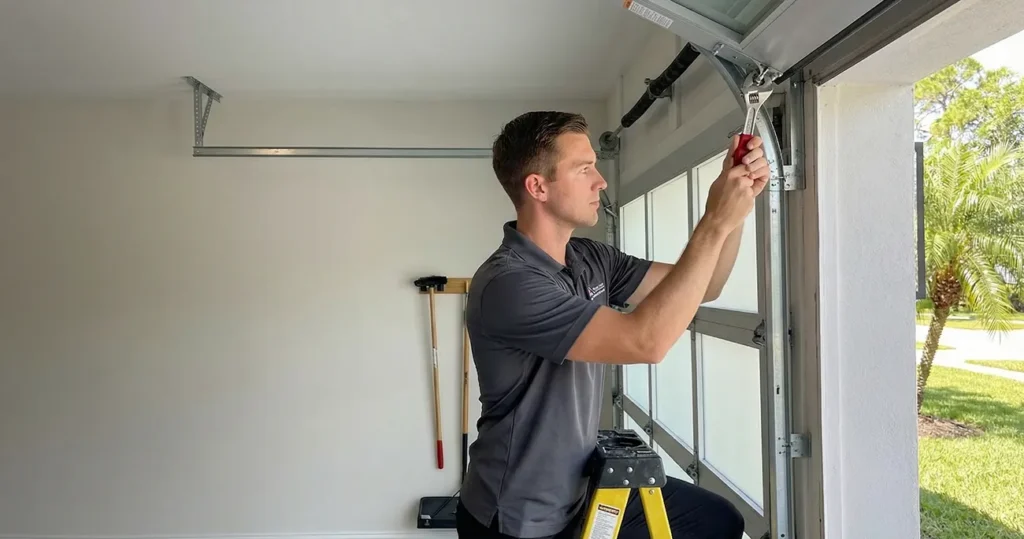
Garage door not working and being repaired

Homeowner's 10-Point Garage Door Safety Checklist

Run through this checklist twice a year. Print it out and tape it to your garage wall. Every item takes less than a minute to check.

  1. Visual spring check: Look at the torsion spring(s) above the door. Any visible gap or separation in the coil means the spring is broken. do not use the door.
  2. Cable condition: Inspect both lift cables for fraying, kinks, or loose strands. Frayed cables can snap under tension.
  3. Photo-eye sensor alignment: Both sensors at the bottom of the tracks should show steady lights. Clean lenses and adjust if blinking.
  4. Auto-reverse test: Place a roll of paper towels in the door’s path and close it. The door must reverse on contact within 2 seconds.
  5. Manual balance test: Disconnect the opener and lift the door halfway. A balanced door stays in place; an unbalanced door needs spring adjustment.
  6. Track inspection: Run your hand along the inside of both tracks to check for dents, bends, or debris.
  7. Hardware tightness: Check all visible bolts, nuts, and brackets for looseness. Vibration from daily use works fasteners loose over time.
  8. Weatherseal condition: The rubber seal at the bottom of the door should be flexible and make full contact with the floor. Replace if cracked or missing chunks.
  9. Emergency release function: Pull the red emergency release cord to verify the door disengages from the opener. Re-engage by lifting the door manually until the trolley clicks.
  10. Opener age & condition: Check the manufacture date on your opener. If it’s over 15 years old or lacks safety features like auto-reverse and photo-eyes, it’s time for a replacement.

Frequently Asked Questions About Garage Door Not Working

These are the questions our technicians hear most often. If yours isn’t listed here, reach out for a free consultation.

How much does garage door repair cost in Sarasota?

Repair costs depend on the specific problem. Spring replacement typically runs $175-$350, cable repair $150-$250, opener repair $100-$300, and off-track repair $125-$225. We provide free estimates with no obligation, and our prices include parts and labor. Get your free estimate here.

We strongly advise against it. Garage door springs are under extreme tension (enough to lift 200-400 lbs), and improper handling can cause severe injury or death. Even experienced DIYers should leave spring work to trained technicians with proper tools. Learn more about our spring repair service.

Standard torsion springs are rated for 10,000 cycles (one cycle = one open + one close). For a household that opens the door 4 times a day, that’s about 7 years. High-cycle springs rated for 25,000-50,000 cycles are available and can last 15-25 years. We install high-cycle springs as our standard option.

The most common cause is misaligned safety sensors at the bottom of the tracks. Clean the sensor lenses and make sure both lights are steady (not blinking). If the door hits the floor and then reverses, the close-limit switch needs adjusting. If neither fix works, there may be a track obstruction or a force setting issue.

We recommend basic monthly checks (visual inspection, listen test), quarterly lubrication and hardware tightening, and an annual professional inspection. Regular maintenance prevents emergency repairs and extends the life of your springs, cables, and opener by years. See our maintenance service for details.

If your opener is over 10-12 years old and having issues, replacement is usually more cost-effective. Modern openers are quieter, more secure (rolling code technology vs. fixed codes), and include safety features that older models lack. If it’s under 10 years and the issue is minor (like reprogramming or sensor alignment), repair makes more sense. Learn about our opener options.

Yes. We provide same-day emergency service for situations where your garage door is stuck open (security risk), stuck closed (car trapped), off-track (safety risk), or has a broken spring or cable. Call us at (941) 226-9542 and we’ll get a technician to you as quickly as possible.

We serve Sarasota, Bradenton, Venice, Lakewood Ranch, Siesta Key, Longboat Key, Osprey, Nokomis, North Port, and surrounding communities in Sarasota and Manatee counties. Same-day service is available throughout our service area.

Still Not Sure What's Wrong? We'll Figure It Out.

You’ve done your homework. If you still can’t pinpoint the problem. or you’ve identified something that needs professional repair. we’re ready to help. Whether your garage door not working is a simple battery issue or something more serious, we are here for you. For any garage door not working emergency, call (941) 226-9542 for same-day service. Every estimate is free, every technician is licensed, and we don’t sell you work you don’t need. That’s why we have over 220 five-star reviews from your neighbors in Sarasota.